Simplicity is Complicated
The best things in life are simple. But, so are the worst ones. Simplicity is a concept that is surprisingly difficult to grasp.
I am a researcher working on autonomous robotics, including deliberation, formal verification, ROS 2, and the open source ecosystems around them.
This site collects my publications, CV, and a blog called Thinkoneering where I write to feed my own curiosity. An article is a success if I learned something from writing it. Below is everything in reverse chronological order. For a structured view, use the categories in the sidebar.
The best things in life are simple. But, so are the worst ones. Simplicity is a concept that is surprisingly difficult to grasp.
This is my personal answer to the European Commissions Call for Evidence on Towards European open digital ecosystems
Christian Henkel, Marco Lampacrescia, Michaela Klauck, Matteo Morelli @ IROS 2025
📄 pdf 🔗 doi: 10.48550/arXiv.2508.18820

A robot is characterized primarily by its versatility. It is a tool that can be used for different tasks in many contexts that each have their own special challenges. This makes it inherently hard to program a robot. Especially, if the resulting robotic system is expected to act autonomously and robustly in unforeseen situations.
Disclaimer: This is about a book that does not exist. But if it would exist, I want to start reading it today!
Enrico Ghiorzi, Christian Henkel, Matteo Palmas, Michaela Klauck, Armando Tacchella @ arXiv
If one were to ask people on the street to name creative jobs, I would not expect software development to be mentioned very often. On the other hand, there are many tasks and activities in the daily work of a software developer that seem very creative to me. I would also describe myself as creative and developing software can be an outlet for this creativity.
In this article I want to explore if software engineering is creative. But this is not only a question of categorization. I want to use this exploration to get a deeper understanding of what creativity is. And I also want to think about the effect of GenAI on the work of software engineers and their creativity.
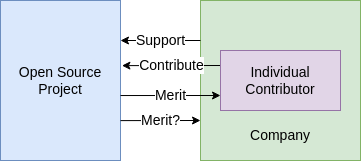
Imagine that you are a maintainer of a widely used open source project relied upon by developers worldwide. Being a maintainer means, that you get to decide which contributions by external contributors get accepted. Now, there are two contributions. One from an individual contributor and one from a person that you know works for a certain company. You know that the individual contributor has worked on the code they are contributing in their free time and you really like the quality of their work. The other contribution is also of high quality. Would you treat these contributions differently? Should you?
Michaela Klauck, Ralph Lange, Christian Henkel, Selma Kchir & Matteo Palmas @ ERF 2024
Charlie Street et al. @ AAAI Fall Symposium 2024